
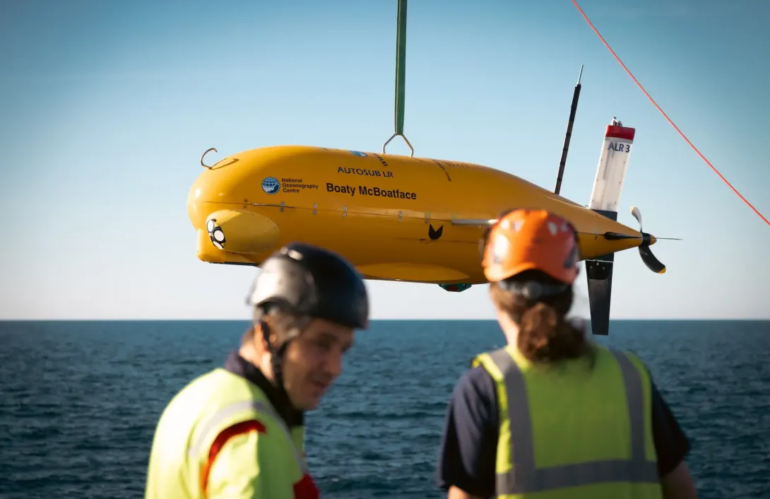
Image Credit: © 2026 The National Oceanography Centre (NOC)
Our planet’s oceans cover more than 70% of the Earth’s surface, regulating climate, absorbing carbon, and sustaining life on a global scale. Yet vast areas remain unexplored, and the ocean’s critical role is often underestimated. Fortunately, the National Oceanography Centre (NOC) exists to deepen our understanding of the ocean in order to address some of the most urgent environmental and societal challenges of our time. As one of the world’s top oceanographic institutions, equipped to develop innovative technologies and bring together leading experts, NOC is uniquely placed to deliver world-class science for real-world impact.
NOC has been a pioneer of ocean technology for decades – from launching their first autonomous vehicle in 1996 to now maintaining one of the world’s largest and most advanced fleets of remotely operated vehicles, gliders, and autosubs. This technology provides marine scientists with the capability to persistently and autonomously monitor the oceans from the surface to their deepest and most remote reaches – places that are exceptionally difficult for humans to access.
Our involvement with NOC relates to their Autosub Long Range (ALR) fleet: autonomous vehicles engineered with a 2,000-kilometre range, a 6,000-metre depth rating, real-time satellite communication, and the endurance to support multi-week missions in extreme and challenging environments. The fleet’s claim to mainstream fame comes from one of its most notable vehicles – famously named ‘Boaty McBoatface‘ following a viral public naming poll.
Our Work with National Oceanography Centre
After many successful missions and years of service, The Marine Autonomous and Robotics System (MARS) team at NOC sought to upgrade the electronics of its Autosub Long Range (ALR) fleet to unlock new capabilities. NOC required a software partner to develop platform software for its new custom hardware, so that its own engineers could remain focused on innovating and iterating the Onboard Control System (OCS) software, which acts as the brain of the autosub. We were engaged to deliver that platform software.
NOC set out its requirements covering operations, manufacturing and ongoing software development. Working to those requirements, we came up to speed with the hardware’s history and the limitations of the existing software distribution, and agreed a delivery approach with NOC before the project commenced.
We began by developing a custom Ubuntu distribution that targeted their custom hardware, which consisted of a Toradex Verdin i.MX8M Plus System-on-Module (SOM) and custom carrier board. Ubuntu was selected by NOC because it is a familiar distribution and a supported operating system of the Robot Operating System (ROS), the framework upon which the OCS is based. Even though Toradex doesn’t provide support for Ubuntu, we were able to leverage some Toradex components from its Yocto distribution to provide bootloader and kernel support, thus allowing us to benefit from the effort and maintenance invested by Toradex.
The build system we provided allowed NOC to build the entire distribution from source in a reproducible and version-controlled manner. This provided artifacts suitable for deployment to eMMC during commissioning or manufacture. This was a great improvement over the existing system, which relied on manual, error-prone steps and the use of pre-provided binary artifacts. We also made it trivial for NOC to customise the distribution (for example, to include dependencies for their software) and include their ROS2-based applications without ongoing external support. Furthermore, through the adoption of a read-only based root filesystem, an enhanced level of consistency and reliability could be achieved, reducing the risk of software issues impacting future missions.
To accelerate their software development, we provided a virtualisation environment that allowed NOC engineers to build and run the distribution and their application on a desktop PC. This approach removed the burden of deploying to physical hardware for each minor iteration and opens the door to automated building and testing via Continuous Integration (CI) in the future.
In a later engagement, NOC developed an enhanced version of the hardware to provide increased wired network bandwidth and to support a new camera system, which was based on the i.MX95. The hardware update also saw a move from the Verdin to the SMARC form-factor for both variants of the board. We were therefore tasked with updating the build system to support the same distribution running on all variants of hardware.
We then moved our attention to power management. Naturally, for an autonomous and self-powered vehicle, any reduction in overall power consumption directly translates to increased range and mission duration. We reviewed the schematics, examined the Linux kernel configuration and evaluated the most efficient means of undertaking periodic work through the use of a variety of power management features offered by the Linux kernel. By looking at the system as a whole we were able to advise on changes that can be made to see minimised power consumption. Finally, we have also continued to support NOC by updating the distribution to the latest LTS versions.
Services Provided
- Hardware Enablement & Bring-up: Toradex: Verdin (i.MX8M Plus), SMARC (i.MX8MP Plus, i.MX95)
- Distribution Development: Ubuntu, ROS2 support
- Optimisation: Power management
- Security: Software maintenance
A Successful Outcome
The platform software we delivered allows NOC to maintain an up to date image for deployment onto the vehicle. It has since been used on a variety of sea trials including under ice in both the arctic and antarctic. In fact, thanks to a live ‘fleet finder‘ portal, you can see exactly where our software and the NOC’s fleet are in the world today.
This project demonstrates what can be achieved where both parties recognise the value the other brings. In this case, success came from a clear set of requirements from NOC and a close working relationship between the two teams. Our engagements with NOC have been both successful and rewarding.
Find out More
The National Oceanography Centre (NOC) is one of the world’s top oceanographic institutions. They undertake world leading research in large scale oceanography and ocean measurement technology innovation; working with government and business to turn great science and technology into advice and applications. They support scientists in universities and research institutes with facilities, research infrastructure and irreplaceable data assets – enabling the UK to harness the full power and diversity of its ocean science talent.

Reach out to us to find out how we can assist you.
Contact Us